
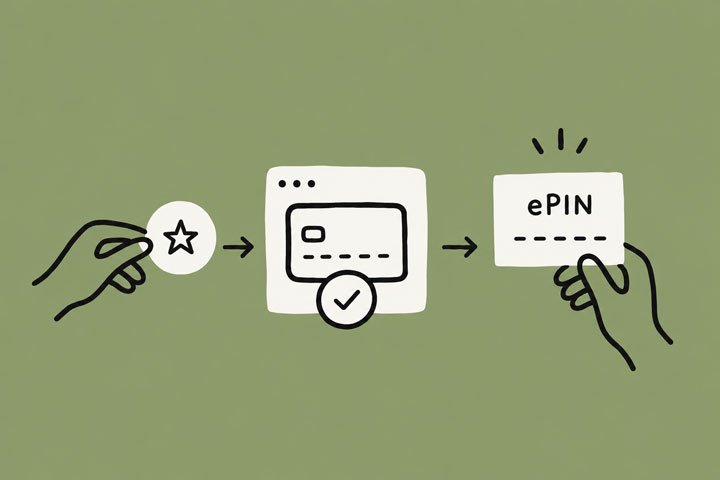
Before UPI, before wallets, Indian telecom operators solved a problem every direct selling company still faces: how do you collect small payments from millions of people, many of whom have cash in hand but no card, no gateway access, and no patience for a failed transaction? Their answer was the prepaid voucher — printed codes sold through lakhs of neighbourhood shops, cash collected locally, value activated centrally. The scratch card built distribution empires. An ePin is that same architecture translated into direct selling: a prepaid, single-use code issued by your company, sold down through your network, and redeemed at the moment a new member joins or an existing one renews. Understanding it properly means seeing not just the code, but the payment topology it creates — one where your sponsors, not a gateway, sit at the point of collection.
The Mechanics: One Code, Three Parties
The lifecycle is short and involves exactly three parties:
- The company generates ePins of fixed denominations — say, the value of a joining package or a renewal fee — and sells them to distributors, receiving payment upfront. Each code is unique, single-use, and tied to a value.
- The distributor holds the ePins as inventory. When a prospect is ready to join, the distributor collects payment from them directly — cash, UPI, a favour repaid, however the two of them settle it — and hands over a code.
- The new member enters the code during registration. The system validates it, marks it consumed, activates the account, and places them in the genealogy under their sponsor.
Notice what the company never touched: the last-mile payment. The transaction between sponsor and recruit happened entirely outside your systems, in whatever form suited two people who already know and trust each other. Your books see only the wholesale event — distributor bought ePins — which happened earlier, in cleared funds.
Why This Beats a Gateway at the Moment of Joining
A payment gateway is the right tool for a stranger buying from your store. Joining a network is a different transaction with different failure modes, and ePin is engineered around them:
Joining happens face-to-face, and momentum is perishable. The industry’s real enrollment moment is a living room, a shop counter, a tea stall — a sponsor and a prospect, decision made, enthusiasm high. Routing that moment through an online checkout introduces every possible point of failure: card declines, OTP delays, gateway timeouts, a prospect who says “I’ll do it tonight” and never does. An ePin closes the enrollment in the same sitting. The prospect pays the sponsor by whatever means is natural between them, the code goes in, the account is live before the tea is finished.
Cash is still real. A meaningful share of prospective members — especially outside metros — operate partly or wholly in cash. A gateway simply cannot receive their money. With ePin, the sponsor becomes the cash-conversion point, exactly as the telecom shopkeeper was.
The economics favour you. Gateway fees of roughly 2–3% apply to every joining transaction you process directly. ePin replaces thousands of retail-sized gateway transactions with a smaller number of wholesale purchases from distributors — and even those can arrive as bank transfers. On thin-margin joining packages, the saved percentage is not decoration.
Revenue arrives before recruitment happens. Distributors buy ePin stock in advance of using it. From a cash-flow standpoint you’ve been paid for enrollments that haven’t occurred yet — a float, in the same family as gift card economics, where issuers enjoy the gap between money received and value redeemed. Which raises obligations, covered below.
The Peer-to-Peer Layer: Codes That Travel
The model becomes fully peer-to-peer when ePins are transferable between members — a leader buys a block of fifty, passes ten to each of five team captains, who each hold them for their own recruiting. The company sold once; the network handled its own internal distribution, exactly as telecom distributors supplied retailers who supplied customers.
Transferability is powerful and must be logged without exception. Every ePin should carry a complete custody chain — generated by whom, sold to whom, transferred to whom and when, redeemed by whom, from which account. That chain is what separates a payment instrument from an untraceable bearer token. When a dispute arrives (“I paid him for a code and never got it”), the log adjudicates it. When a regulator asks how joining fees flow through your business, the log answers.
The Controls That Keep It Clean
An ePin system without discipline is a fraud surface. The non-negotiables:
- Expiry dates. Open-ended codes become a permanent liability on your books and a stale-inventory problem in the field. Expire them — commonly 6–12 months — and define upfront what happens to expired value (refund to the buyer’s wallet is the defensible answer; silent forfeiture invites disputes).
- Denominations locked to real products. ePins should map to actual joining packages and renewals, not arbitrary stored value. The moment ePins become free-floating money, you’re operating a private currency with none of the licensing that entails.
- Rate and volume sanity checks. Flag accounts buying or transferring ePins at volumes disconnected from their recruiting activity — hoarding and resale-at-markup schemes both start there.
- Blockability. Admin must be able to freeze a specific code or a member’s entire ePin inventory instantly when something smells wrong, before redemption converts a suspicion into a genealogy entry.
- Honest accounting. Money received for unredeemed ePins is deferred revenue — an obligation, not income. Recognise it at redemption or expiry, and reconcile the outstanding-ePin liability monthly against the custody log. This single practice is most of the difference between an ePin programme that survives an audit and one that doesn’t.
These controls are why ePin capability belongs in the platform core rather than bolted on. In MLMOrbit, ePin generation, denominations, transfer logging, expiry handling, and block controls are native admin functions, and because the system is self-hosted, the full custody log lives in your own database — auditable by you, on demand, without asking anyone.
The telecom scratch card looked like a piece of cardboard; it was actually a payment network built out of shopkeepers. ePin looks like a discount code; it is actually your network monetising the thing it uniquely has — trusted, face-to-face relationships at the last mile — while your company collects wholesale, upfront, and gateway-free. Run it with custody logs, expiries, real denominations, and deferred-revenue discipline, and you get the reach of cash with the auditability of software. The rest of this series covers what that unlocks: sponsor-funded joining, cross-border recruitment, and where the instrument’s limits sit.


0 Comments