

Direct selling networks have always outrun their infrastructure. A distributor in Chennai has a cousin in Dubai; the cousin has colleagues in Nairobi; within a month there’s genuine demand for your opportunity in two countries where your company has no entity, no bank account, and no payment gateway — and no gateway will onboard you without those. The conventional answers are both bad: turn the demand away, or attempt to process international card payments and watch them fail, since cross-border transactions are declined at roughly 15–25% compared to 1–5% domestically, with foreign-exchange fees of 1.5–3.5% taken out of whatever survives. ePin offers a third answer, and it’s the same one that has moved value across borders for centuries: don’t move the retail money across the border at all. Move one wholesale payment, and let the value travel as codes.
## The Model: One Wire, Then Everything Local
Recall from earlier in this series that ePin’s defining property is separating the company’s collection point from the network’s. Applied across a border, that separation becomes the entire expansion strategy:
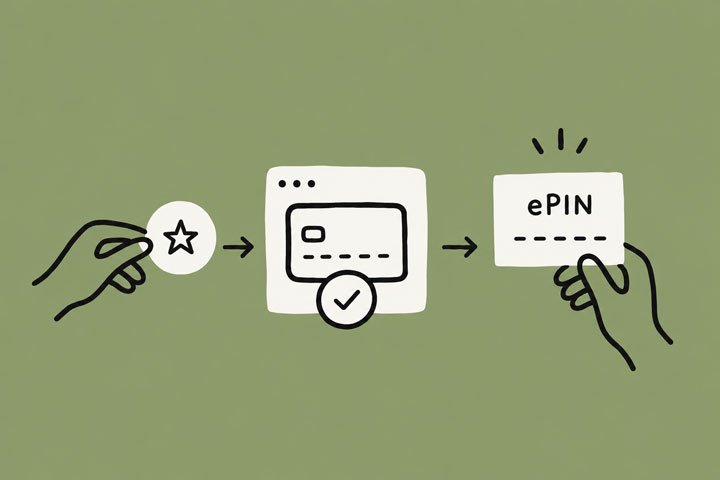
– **The company sells a block of ePins to a country leader** — the Dubai cousin, now your anchor in that market. This is a single wholesale transaction: one international bank transfer, in your currency or theirs, cleared through the formal banking system with full documentation. The 15–25% retail decline problem never arises because there are no retail cross-border transactions.
– **The leader distributes locally.** They sell or transfer ePins to their recruits, collecting in dirhams, shillings, or whatever instrument local trust runs on — bank transfer, cash, local wallet apps your gateway has never heard of. Every last-mile payment is domestic, which is precisely the condition under which payments actually work.
– **Redemption is borderless because it’s digital.** The new member enters the code; the system activates the account and places them in the genealogy. Software doesn’t care where the browser is.
One cleared wire replaces hundreds of doomed card attempts. And notice the risk allocation: the company was paid upfront, in full, before a single overseas member joined. The country leader carries the local collection risk — which is appropriate, because the country leader is the only party with the local relationships to manage it.
## Multi-Currency Denominations Without Currency Operations
A practical detail that decides whether this scales: ePins should be denominated per market, mapped to a locally sensible package price — not one global figure mangled by exchange rates. A joining package worth ₹3,000 in India is not automatically the right price point in Nairobi, and a code denominated in a currency the recruit doesn’t think in adds friction back in.
The elegant part is that offering AED-, KES-, or USD-denominated ePins does not make you a currency trader. You price the wholesale block to the country leader however you both settle it; the denominations are labels on packages, and your exposure begins and ends at the wholesale transaction. Your platform simply needs to support per-market pin values — and to keep the custody log unified across all of them, because that log is about to become your most important document.
## The Country-Launch Pattern
Used deliberately, this becomes a staged market-entry playbook rather than an accident of growth:
– **Stage one — the probe.** One trusted leader, one modest ePin block, no entity, no localisation. You’re buying information: does this market’s demand survive contact with reality? Your total exposure is the cost of supporting a handful of accounts.
– **Stage two — the readout.** The custody and redemption data tells you what a market study never could: how fast codes convert to activations, whether activated members produce PV, whether second-generation recruiting starts. Real behaviour, not survey answers.
– **Stage three — the decision.** Markets that clear the bar justify the real investment — local incorporation, local compliance, local payment rails, product logistics. Markets that don’t have cost you almost nothing to test.
Compare that sequence to the traditional one — incorporate first, license first, then discover there’s no demand — and ePin’s real value abroad becomes clear: it converts market entry from a bet into an experiment.
## The Lines This Does Not Let You Cross
Now the part a serious operator needs stated plainly: ePin solves payment logistics. It does not create legal permission, and treating it as if it did is how companies convert a growth story into an enforcement story.
– **Local direct selling law applies to you, entity or no entity.** India’s own Consumer Protection (Direct Selling) Rules, 2021 explicitly cover foreign entities offering goods or services to Indian consumers — and India is not unusual. If a country regulates direct selling, recruiting its residents puts you in scope, whether or not money crossed a border through your systems. The probe stage buys you time to learn a market, not exemption from its rules; take legal advice before stage one, not after stage three.
– **Undocumented value transfer has a name, and regulators don’t like it.** A system moving value across borders outside banking channels, on trust, settled separately — that’s the definition of informal value transfer (hawala being the famous example), and anti-money-laundering frameworks exist to watch for it. What keeps ePin on the right side of that line is exactly what keeps it clean domestically, only more so: the wholesale payment through formal banking with invoices, the complete custody chain on every code, KYC on every redeeming account, and volume monitoring on cross-border transfers. Your ePin ledger should let you reconstruct any code’s journey — issued, sold, transferred, redeemed, by whom, from where — on demand. If it can, you’re running a documented distribution system; if it can’t, you’re running something a financial-intelligence unit will characterise for you.
– **Tax follows activity.** Sustained volume in a market raises permanent-establishment and local tax questions regardless of payment mechanics. Cross that bridge deliberately, with an accountant, at stage three.
These aren’t reasons to avoid the model — they’re the operating manual for it. The companies that get hurt are the ones that mistake “the payments work” for “the business is compliant.”
## What the Platform Must Provide
The whole architecture rests on a small set of capabilities: per-market pin denominations, transfer with mandatory custody logging, KYC enforcement at redemption, per-country reporting on issuance and activation, and admin block controls that work instantly across the whole inventory. In MLMOrbit these are core ePin functions rather than add-ons, and self-hosting adds the property that matters most when regulators anywhere ask questions: the complete cross-border custody record sits in your own database, exportable on your own authority, not mediated by a vendor in a third country.
Networks grow along relationships, and relationships have never respected borders — the only thing that ever stopped at customs was the payment infrastructure. ePin moves the border problem from a thousand fragile retail transactions to one documented wholesale one, prices each market in its own language, and turns international expansion into a sequence of cheap, measurable probes. Do it with the custody log intact, local law respected, and the formal banking system carrying the wholesale leg — because the model’s genius is that it makes cross-border growth easy, and its discipline is remembering that easy and permitted are different words.

0 Comments