
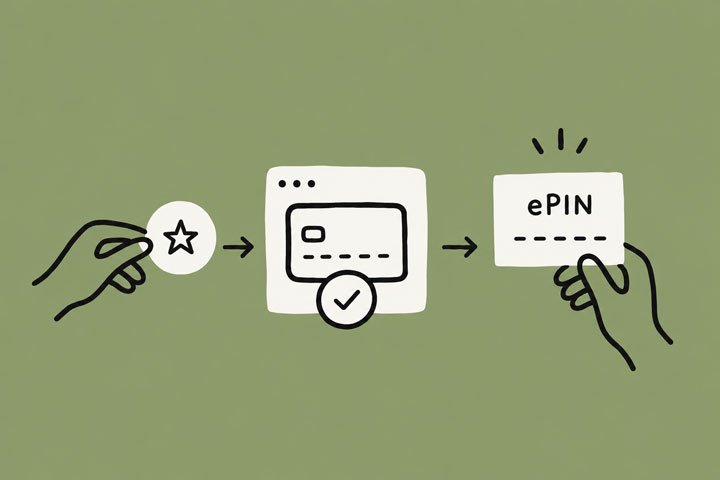
Put an ePin and a gift card side by side in a database and they’re nearly indistinguishable: a unique code, a value, an issued-on date, a redeemed-by field. This resemblance is why so many MLM platforms — and founders — treat them as one feature with two names, and why that mistake propagates quietly into plan design, accounting, and compliance. The truth is that they are different instruments serving different business functions, the way an invoice and a receipt are both “documents about money” while doing opposite jobs. This closing post in the ePin series draws the boundary precisely: what each instrument is for, where their behaviours must differ, and why keeping them separate is a design requirement rather than a preference.
ePin Points Inward: The Membership Instrument
Everything covered in this series — the sponsor-as-gateway mechanics, sponsor-funded joining, cross-border wholesale distribution — describes an instrument whose audience is your network. An ePin’s buyer is a distributor; its redeemer is a new or renewing member; its value maps to a specific membership event — a joining package, a renewal, an upgrade. It travels peer-to-peer through the genealogy precisely because internal distribution is its job, and every hop is custody-logged because the network is also where its fraud risk lives.
Its business function, in one line: ePin is recruitment and renewal logistics. It converts the network’s trust relationships into payment infrastructure and gives enrollment a documented, gateway-free rail. When it’s working, you see it in activation speed, cross-border reach, and clean joining audit trails — member-side metrics, all of them.
Gift Cards Point Outward: The Retail Instrument
A gift card is aimed at people who may never join anything: customers. Its buyer is anyone; its redeemer is whoever receives it; its value is open stored credit spendable across your product catalogue rather than a token for one defined event. Nothing about it should know or care about your genealogy.
Its business functions are the classic retail ones:
- Customer acquisition by gifting. Every card purchased is an existing customer paying to introduce your products to someone new — word-of-mouth with money attached. For a manufacturer building a direct channel, this is a marketing instrument your distributors can retail alongside products.
- Float. Card money arrives at sale; the goods leave at redemption, sometimes months later. At scale this interest-free financing is famous — Starbucks carries so much unspent card value at any moment that commentators like to note it holds more customer deposits than some small banks.
- Breakage. Some fraction of card value is never redeemed at all. It eventually becomes income — but under rules, not whim: accounting standards govern when breakage can be recognised, and (as covered below) Indian regulation adds its own waiting periods. Breakage is a modest bonus to plan around, never a revenue line to build on.
Notice that all three functions are customer-side and catalogue-wide — the mirror image of ePin’s member-side, event-specific role.
Five Dimensions, Five Different Answers
The boundary becomes unmistakable when you ask the same design questions of both instruments:
- Who buys it? ePin: distributors, often in wholesale blocks. Gift card: anyone, usually one at a time.
- Who redeems it? ePin: a member account, with KYC, landing in the genealogy. Gift card: any customer, no membership implied — forcing enrollment on a gift recipient is how you turn a marketing tool into a complaint.
- What does it buy? ePin: one defined membership event at a fixed denomination. Gift card: anything in the catalogue, partially spendable, balance remaining.
- Should it transfer? ePin: yes, through the network, with a mandatory custody chain. Gift card: it changes hands once, giver to recipient, outside your systems entirely — building network-transfer features into gift cards creates an internal value rail you never intended.
- What does redemption trigger? ePin: account activation, genealogy placement, possibly a sponsor’s fast-start clock. Gift card: an order, and nothing else. No PV, no commissions, no qualification credit should flow from the card itself — commissions belong to product sales, and letting stored-value events into the compensation engine double-counts the same rupee.
Five questions, five opposite answers. Instruments that disagree on every design dimension are not one feature.
The Regulatory Line Both Must Respect
In India, both instruments live under the shadow of the RBI’s Prepaid Payment Instrument framework — and both stay comfortable there for the same reason. The PPI Master Directions carve out closed-system PPIs: instruments issued by an entity and redeemable only for that entity’s own goods and services are not classified as payment systems, require no RBI authorisation, and sit outside RBI supervision. A joining-package ePin redeemable only on your platform and a gift card spendable only in your own store are both squarely inside that carve-out.
The exemption is a description of behaviour, not a label you claim — and it’s lost by drift, not decision:
- Let the instrument buy goods from third-party merchants, and you’ve built a semi-closed PPI: RBI authorisation territory, with net-worth floors in the crores and full compliance overhead.
- Let it behave like transferable open money — loadable, cash-out-able, or usable as a general payment rail between members — and you’re operating something regulators will classify for you, on their timetable.
- Even inside the carve-out, consumer-protection expectations around validity periods, expiry warnings, and refunds of expired value are the standard your gift card programme should meet voluntarily — they’re cheap, and they’re where disputes come from.
This is the deepest reason the two instruments must stay architecturally separate. Each one, scoped to its job, is a boring closed-loop voucher. Merged into one flexible “credits” system that joins members, buys products, transfers freely, and stores open value, the combined instrument starts resembling exactly the thing that requires a licence.
Run Both — Separately
The practical conclusion isn’t to choose between them; a direct selling company plausibly wants both. The manufacturer building a direct channel uses gift cards to let happy customers recruit customers, while ePins let committed members recruit members — two growth loops, two instruments, one platform. What matters is that the platform treats them as distinct objects: separate ledgers, separate rules, separate reports. In MLMOrbit, ePins and vouchers are independent modules — ePins carry custody chains and genealogy hooks, gift vouchers carry balances and order hooks, and neither can wander into the other’s job, which is precisely the property that keeps both of them simple.
Instruments earn their keep by being narrow. The ePin is powerful because it does exactly one thing — move membership events through a trusted network with a paper trail — and the gift card is powerful because it does a different one thing: turn customer goodwill into prepaid retail demand. Fuse them and you inherit the fraud surface of both, the accounting clarity of neither, and a regulatory classification you no longer control. Keep them twins in appearance and strangers in function, and each will quietly do its job for years without ever appearing in a board meeting — which is the highest compliment infrastructure can receive.

0 Comments