
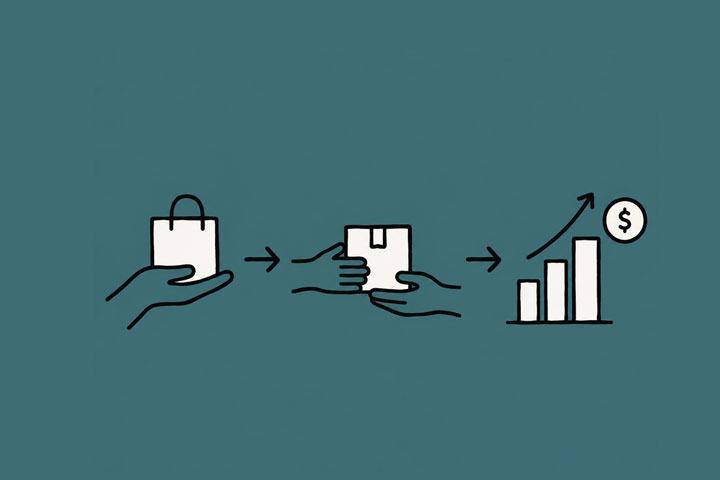
There’s a reason luxury brands almost never discount and a reason grocery brands that discount constantly can never stop: price cuts work once, then they work against you. Marketing research has documented the pattern for decades — repeated price promotions raise customer price sensitivity and erode brand equity over time, and one retail study found discount-motivated first-time buyers were roughly half as likely to ever purchase again. Direct selling companies have a tool that sidesteps this trap entirely, and most barely use it: the PV table. Because your distributors respond to point value the way price-shoppers respond to markdowns, you can redirect demand through the compensation plan while your retail price never moves.
## Why PV Incentives Don’t Carry the Discount Penalty
A discount is public. It tells every customer — including the ones who paid full price last week — that the number on the tag was negotiable. A PV boost is internal. The customer sees the same price; only the distributor’s incentive changed. That single difference eliminates the three costs that make discounting expensive:
– **No reference-price damage.** Customers never see a lower number, so they never anchor to one and never learn to wait.
– **No margin surprise on retail sales.** Your revenue per unit is unchanged; the cost of the campaign is a bounded, calculable increase in commission exposure on that SKU.
– **No brand-quality signal.** Deep discounts make consumers suspect something is wrong with the product. A PV boost sends no consumer-facing signal at all.
The trade-off is honest and should be priced: a PV boost is a temporary payout-rate increase on that product. If a SKU normally carries 60 PV and you run it at 90, your commission exposure per unit rises by exactly the payout percentage times 30 PV. You know the campaign’s maximum cost before it starts — which is more than anyone running a “20% off” weekend can say.
## The Four Campaign Types
**The launch window.** New SKUs die from inattention, not rejection — distributors keep selling what they already know how to sell. A 60–90 day elevated PV gives the network a concrete reason to demo the new product to their customers *now*. The goal isn’t the boosted-period sales; it’s the retail habits and testimonials that survive after PV returns to normal. If sales collapse fully back to zero when the boost ends, the product failed and the campaign just told you cheaply.
**The clearance alternative.** Slow inventory usually gets a markdown. Try a PV boost first: the network absorbs and retails the stock while price integrity holds. This matters most for manufacturers moving to direct channels from marketplaces — you likely came here partly to escape the race-to-the-bottom pricing culture, so don’t rebuild it inside your own network.
**The basket-builder.** Assign a PV bonus to a bundle rather than a single SKU — the starter kit plus the consumable refill, the device plus the service plan. You’re using PV to teach the network which *combination* to sell, which raises average order value without any pricing gymnastics.
**The seasonal pulse.** Predictable, calendar-based PV events (festival season, financial year-end) give leaders something to rally their teams around. Keep them short and genuinely periodic — a boost that never ends is just a permanently higher payout rate wearing a party hat.
## Autoship PV: The Repeat-Purchase Dial
Where campaign boosts steer *which* products move, autoship weighting steers *how* they move. Assigning subscription orders slightly higher PV than one-off orders — or letting autoship PV count more generously toward monthly activity requirements — converts the network’s qualification pressure into recurring revenue for you.
Handle this dial with care, because it sits next to a regulatory wire. Autoship PV should reward genuine consumption patterns, not manufacture them: pair it with easy cancellation and reasonable volumes, or you’ve built an inventory-loading machine with a subscription interface. The weighting should make the convenient behaviour slightly better rewarded, not make non-subscription participation unviable.
## Qualification Floors: The Demand You Can Forecast
The quietest demand lever in the whole system is the monthly activity floor — the minimum PV a distributor must generate to stay active and commission-eligible. Set at, say, 100 PV/month across 5,000 active distributors, the floor establishes a baseline monthly volume you can actually plan production and inventory around. It’s the closest thing direct selling has to a demand forecast you control.
Two design rules keep it healthy. First, the floor should be reachable through ordinary personal consumption plus modest retail effort — a floor only reachable by stockpiling is a churn engine. Second, when you weight retail-sale PV above self-purchase PV (as covered earlier in this series), the floor pushes distributors toward finding customers rather than filling garages, which is exactly the behaviour regulators want to see documented.
## Measuring Whether a Campaign Worked
A PV campaign without measurement is a payout increase with a story attached. The minimum readout, per campaign:
– **Unit lift during the window** versus the trailing baseline for that SKU — and versus the network’s overall trend, so growth elsewhere doesn’t masquerade as campaign effect.
– **Post-campaign retention**: what percentage of the lifted volume persists 30 and 60 days after PV normalises? This is the number that distinguishes habit-building from a pull-forward, where distributors simply shifted orders they’d have placed anyway into the boost window.
– **Cost per incremental unit**: extra commission paid during the window divided by units above baseline. Compare it to what an equivalent price discount would have cost in margin *plus* reference-price damage; PV usually wins, but let the numbers say so.
– **New-buyer share**: lift concentrated among distributors who never sold the SKU before is expansion; lift concentrated among existing sellers buying deeper is closer to loading.
This is why PV values need to be operator-editable with date ranges, and why campaign-period reporting must sit in the same system as the PV table. In MLMOrbit, product PV is a field you change in the admin panel and your order data lives on your own server — so running a 90-day boost and pulling the before/after query is a Tuesday afternoon, not a change request to a vendor.
Discounting spends brand equity to buy volume; PV configuration spends a known slice of commission to *direct* volume — and only one of those is recoverable. Run launches, clearances, bundles, and seasonal pulses through the PV table, keep the boosts time-boxed, weight autoship and floors toward real consumption, and measure the residual lift, not the window spike. Your price list stays clean, your demand becomes steerable, and your network learns to respond to your compensation plan instead of waiting for your markdowns — which is, after all, why you built a compensation plan in the first place.


0 Comments